Sweetwater CRA — Project Review
Confidential draft prepared for City review. Please enter the review passcode to continue.
Incorrect passcode — please try again.
Confidential draft prepared for City review. Please enter the review passcode to continue.
The statutory analysis under Chapter 163, Part III, Florida Statutes determining whether slum and blight conditions exist — and whether redevelopment is necessary. Draft · Mar–Apr 2026
In January 2026, the City undertook a comprehensive, data-driven analysis pursuant to §163.355, F.S., evaluating the proposed area against the criteria for slum and blight in §163.340(8), F.S. The evaluation drew on government demographic and economic data, property-appraiser records, public-safety, code-enforcement and emergency data, infrastructure records, and field inspections with photographic assessment.
Field observations, infrastructure assessments, and municipal records confirm multiple statutory indicators of slum and blight that collectively impair the sound growth of the City and constrain private reinvestment.
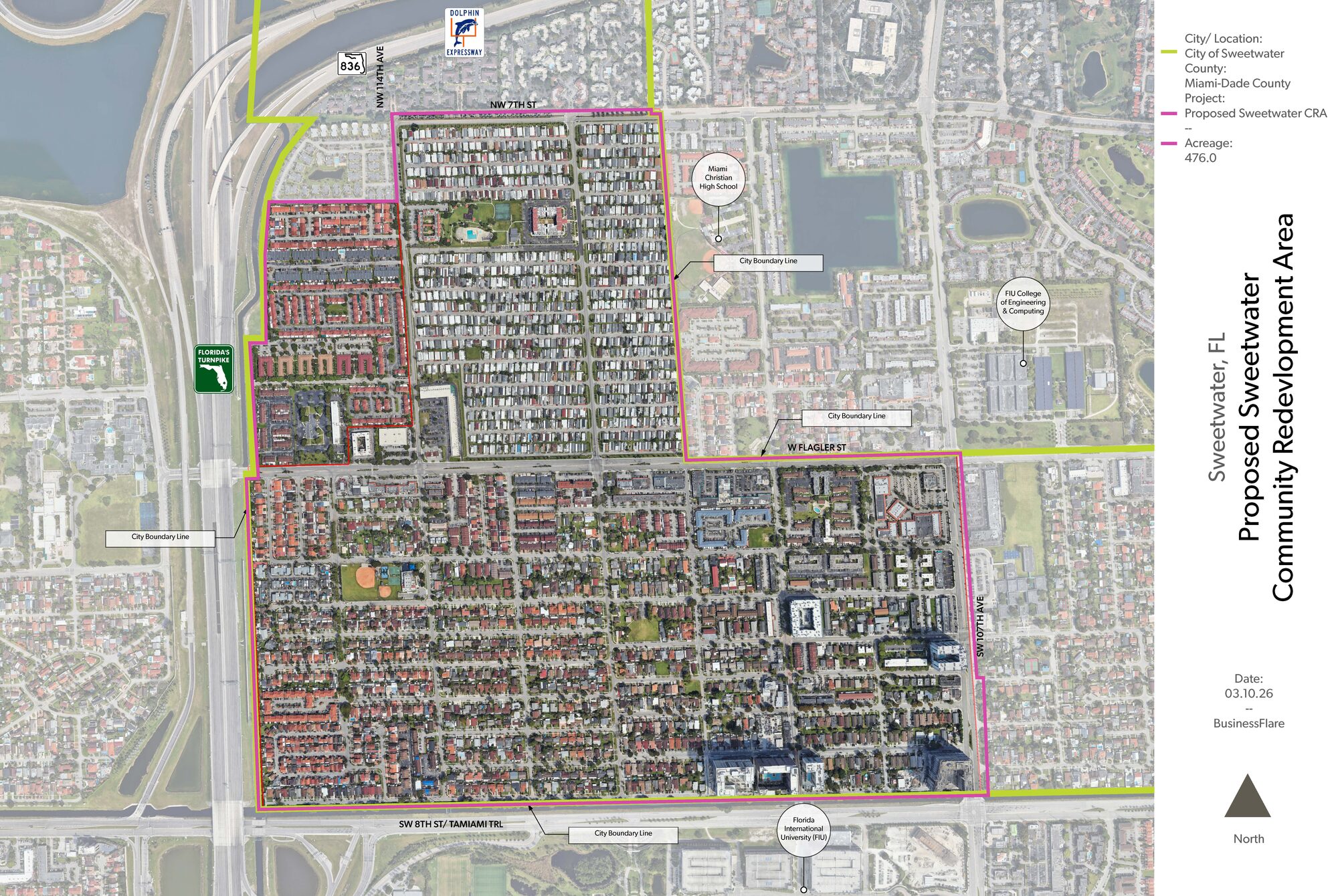
Two factors sharpen the case: the area's proximity to FIU and the City's University City District — intended as its primary mixed-use activity center — and the ~104-acre former trailer-home park near downtown, one of the largest contiguous underutilized sites in the City.
Government demographic and economic data, property-appraiser and land-use records, and capital-improvement records.
Police, code-enforcement, and emergency-services data reviewed against the statutory criteria.
On-the-ground visual and photographic assessment of building and site conditions.
Guided by §163.340(8), F.S., with attention to identifying two or more qualifying indicators of blight.
One slum-area condition and multiple blight criteria were documented within the proposed CRA — well beyond the statutory threshold.
Deteriorated, structurally distressed buildings; outdated overhead utility infrastructure increasing fire risk; and unsanitary conditions including illegal dumping of debris and solid waste.
Deteriorated roadways, damaged or non-compliant sidewalks, inadequate drainage, and limited pedestrian and transit-supportive facilities.
Inefficient parcels, constrained vehicular access, insufficient parking, and fragmented land use that hinder reinvestment.
Dilapidated and aging structures — notably near SW 109th Avenue in Downtown Sweetwater — raising public-safety and code concerns.
Elevated public-safety demand documented through municipal records within the proposed area.
Concentrated code-enforcement activity and deterioration of sites and improvements across the area.
The City finds that redevelopment is necessary to eliminate deteriorating conditions, promote private reinvestment, improve infrastructure, and advance public health, safety, and welfare. Establishing a CRA under Chapter 163, Part III, F.S. is the appropriate and lawful mechanism to guide this transformation.